

Every experienced property stylist knows that some spaces just feel right. The light is good, there are plants, the materials are warm and tactile — and buyers walk in and immediately feel at home.
Most stylists attribute this to good taste or good instincts. And those things matter. But there's a more precise explanation — one rooted in evolutionary biology and neuroscience — and understanding it makes you a significantly better stylist.
I've been training property stylists for over a decade. The biophilic design module in the IIHS curriculum exists because this science is directly applicable to what stylists do every day. Here's what the research actually says — and why it matters for how you stage a property.
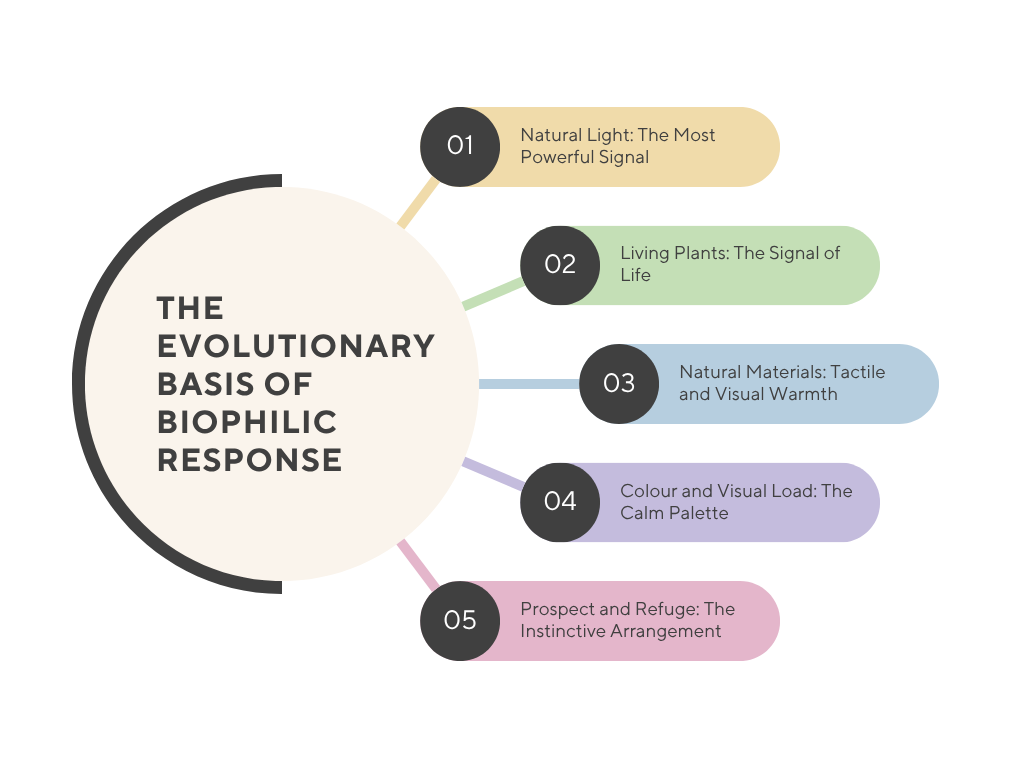
The Evolutionary Basis of Biophilic Response
Humans evolved in natural environments over hundreds of thousands of years. Our nervous systems were calibrated in landscapes of trees, water, open sky, and organic forms — not in offices, apartments, or shopping centres.
The built environment is, in evolutionary terms, extremely recent. Our brains haven't caught up. When we encounter elements of the natural world — natural light, living plants, water, organic materials — our nervous systems respond as they always have: with a signal of safety, resource availability, and calm. This is the core insight of biophilic design. It's not that natural elements are aesthetically pleasing (though they often are). It's that they trigger a biological response that synthetic environments don't. And that response — calm, safety, welcome — is exactly what you want a buyer to feel when they walk through a property.
Natural Light: The Most Powerful Signal
Of all the biophilic elements, natural light has the most significant and well-documented effect on human wellbeing.
The mechanism is direct. Natural light regulates the circadian rhythm — the internal clock that governs sleep, mood, energy, and hormonal balance. Exposure to natural light suppresses melatonin (the sleep hormone) and promotes serotonin (the mood-regulating hormone). A space with good natural light makes people feel alert, positive, and energised.
The research is consistent: people in naturally lit environments report higher mood, lower stress, better concentration, and greater satisfaction with their environment than people in artificially lit spaces. In workplace studies, access to natural light is consistently rated as the most important environmental factor for wellbeing — above temperature, noise, and even salary. For property styling, the implication is clear. Natural light isn't just a nice feature — it's the single most powerful biophilic signal a property can offer. Maximising it (opening curtains, cleaning windows, removing obstructions) is the highest-impact, lowest-cost intervention available to a stylist.
Glare is the enemy. Harsh direct sunlight creates stress rather than calm — it activates the same threat-detection systems that evolved to protect us from predators. Managing glare (sheer curtains, strategic furniture placement, external shading) is as important as maximising light.
Living Plants: The Signal of Life
Plants are the most universally recognised biophilic element — and their effect on human psychology is well-documented. The evolutionary logic is straightforward. In the environments humans evolved in, the presence of healthy vegetation signalled resource availability: food, water, shelter, clean air. A landscape with thriving plants was a safe landscape. Our nervous systems still read that signal.
Research shows that the presence of living plants in an environment reduces cortisol (the stress hormone), lowers blood pressure and heart rate, improves mood and concentration, and increases feelings of calm and wellbeing. These effects are measurable within minutes of entering a plant-filled space — and they occur whether or not the person is consciously aware of the plants. For property styling, this means a living plant isn't decoration. It's a biological signal that the space is alive, cared for, and safe. A large, healthy plant in a living room changes how the room feels — not just how it looks.
The key word is living. Artificial plants don't produce the same response. The biophilic effect is triggered by the presence of actual living organisms — their movement, their scent, their subtle changes over time. A silk plant in a corner is better than nothing, but it's not the same thing.
Natural Materials: Tactile and Visual Warmth
Natural materials — timber, stone, linen, wool, rattan, leather — engage the senses in ways synthetic materials don't. And the reason is, again, evolutionary.
These materials have variation. Timber has grain. Stone has texture. Linen has weave. Wool has depth. These variations are what neuroscientists call "fractal patterns" — patterns that repeat at different scales, like the branching of trees or the rippling of water. Fractal patterns are found throughout the natural world, and research shows that the human visual system processes them with significantly less effort than the uniform, repetitive patterns of synthetic materials. Less cognitive effort means less stress. A room furnished with natural materials is literally easier for the brain to process — and that ease registers as comfort, warmth, and welcome.
There's also a tactile dimension. Natural materials invite touch in a way synthetic materials don't. A linen cushion, a timber tabletop, a stone bowl — these objects engage the sense of touch and create a sense of physical connection to the space. Buyers who touch things in a property are buyers who are imagining themselves living in it. For property styling, the practical implication is to prioritise natural materials in furniture and accessory selection wherever possible. Timber over laminate. Linen over polyester. Stone over plastic. Rattan over chrome. The difference in how a room feels — not just looks — is significant.
Colour and Visual Load: The Calm Palette
The colour palette of a styled property has a direct effect on the nervous system — and biophilic design has a clear position on what works.
Natural colour palettes like earthy neutrals, warm whites, sage greens, stone tones, terracotta are the colours of the environments humans evolved in. They're familiar at a biological level. They reduce visual stress and create a sense of calm. High-contrast, high-saturation colour schemes — bright whites against dark greys, bold feature walls, clashing accent colours increase visual load. They activate the nervous system rather than calming it. In a property walk-through, that activation reads as discomfort, even if the buyer can't articulate why. Visual load is the total amount of visual information a space asks the brain to process. High visual load (too many colours, patterns, objects, or competing focal points) is tiring. Low visual load (a calm palette, minimal accessories, clear sightlines) is restful. Buyers who feel rested in a property are buyers who want to come back.
Prospect and Refuge: The Instinctive Arrangement
One of the most powerful and least understood biophilic principles in property styling is prospect and refuge. Prospect is the sense of openness and visibility — a view, a sightline, a feeling of being able to see what's coming. Refuge is the sense of shelter and enclosure — a wall at your back, a ceiling overhead, a protected position. In the environments humans evolved in, the ideal position was one that offered both: a sheltered spot with a clear view of the surrounding landscape. This is why humans instinctively prefer to sit with their backs to walls, facing the room. It's why a reading nook beside a window feels so appealing. It's why a sofa floating in the middle of a room feels uncomfortable.
For property styling, this principle has direct implications for furniture arrangement. A sofa with its back to a wall, facing a window or a view, creates prospect and refuge. A dining table positioned so diners face the room (not a wall) creates prospect. A reading chair tucked into a corner with a lamp creates refuge. These arrangements feel instinctively right — because they are.
What This Means for Property Stylists
The science of biophilic design gives property stylists something more valuable than good taste: a framework for making intentional decisions.
When you understand why natural light makes buyers feel positive, you don't just open the curtains — you think about light quality, direction, and glare management. When you understand why living plants signal safety, you don't just add a plant — you choose a healthy, well-placed specimen that reads as thriving. When you understand why natural materials reduce cognitive load, you don't just pick timber over laminate because it looks nicer — you know it will make the room feel easier to be in.
That depth of understanding is what separates stylists who create beautiful spaces from stylists who create spaces buyers genuinely respond to. And it's what the IIHS biophilic design module is designed to give you.
A Note on Training
The Institute of Home Staging is the only property styling training institute in Australia that includes biophilic design as a dedicated module. The course is self-paced, online, with four full-day immersion sessions per year.
Learn more at instituteofhomestaging.com.
FREQUENTLY ASKED QUESTIONS
Q: Why do buyers respond emotionally to natural light in a property?
A: Natural light regulates the circadian rhythm and promotes serotonin — the mood-regulating hormone. A space with good natural light makes people feel alert, positive, and energised. This response is biological, not aesthetic — it happens whether or not the buyer is consciously aware of the light quality. Research consistently shows that natural light is the most important environmental factor for human wellbeing in built spaces.
Q: Do artificial plants have the same effect as real plants in a styled property?
A: No. The biophilic response to living plants is triggered by the presence of actual living organisms — their movement, their scent, their subtle changes over time. Artificial plants don't produce the same neurological response. A well-chosen artificial plant is better than nothing in terms of visual warmth, but it doesn't deliver the cortisol-reducing, mood-improving effect that living plants do. Where possible, use living plants.
Q: Why do natural materials feel warmer than synthetic ones?
A: Natural materials have fractal patterns — variations in grain, texture, and weave that repeat at different scales, like the patterns found throughout the natural world. The human visual system processes fractal patterns with significantly less cognitive effort than the uniform, repetitive patterns of synthetic materials. Less cognitive effort registers as comfort and warmth. There's also a tactile dimension: natural materials invite touch in a way synthetic materials don't, creating a sense of physical connection to the space.
Q: What is prospect and refuge, and why does it matter in property styling?
A: Prospect and refuge is a biophilic principle describing the human preference for positions that offer both openness (a view, a sightline) and shelter (a wall at your back, an enclosed position). It's rooted in evolutionary biology — the ideal position in a natural landscape was one that offered both safety and visibility. In property styling, it applies to furniture arrangement: a sofa with its back to a wall facing a window, a reading chair in a corner with a lamp, a dining table where diners face the room. These arrangements feel instinctively right because they mirror the environments humans evolved in.
Q: Does the colour palette of a styled property really affect buyers?
A: Yes — measurably. Natural colour palettes (earthy neutrals, warm whites, sage greens, stone tones) are familiar at a biological level and reduce visual stress. High-contrast, high-saturation colour schemes increase visual load and activate the nervous system. In a property walk-through, that activation registers as discomfort — even if the buyer can't articulate why. A calm, grounded palette is one of the most reliable ways to create the emotional response you want buyers to have.
Q: How quickly do biophilic elements affect a buyer's emotional response?
A: Research shows that the effects of biophilic elements — reduced cortisol, lower heart rate, improved mood — occur within minutes of entering a space. The emotional response to a property is formed in the first few minutes of a walk-through, before the buyer has consciously assessed the features. This is why biophilic design matters so much in property styling: it shapes the emotional impression that drives purchase decisions, before rational evaluation even begins.
Q: Is there research supporting biophilic design in real estate specifically?
A: The research base is strongest in workplace and healthcare settings, where biophilic design has been shown to reduce stress, improve wellbeing, and increase productivity. In residential settings, studies consistently show that properties with natural light, greenery, and natural materials are perceived as more desirable and more valuable. The mechanism is the same: biophilic elements trigger a biological response of calm and safety that translates into emotional preference — and emotional preference drives purchase decisions.
Q: Where can I learn to apply biophilic design in property styling?
A: The Institute of Home Staging (IIHS) is the only property styling training institute in Australia that includes biophilic design as a dedicated module. The course covers the science behind biophilic responses, the ten core elements of biophilic design, and how to apply them practically in property styling. Self-paced, online, with four full-day immersion sessions per year. Visit instituteofhomestaging.com.
Comments